Wholestory

Last Updated: July 27, 2026

The Ukraine-Russia War

The front stopped and the strike campaign went deeper than it ever has. ISW confirmed no advance by either side anywhere on the front on July 24, 25, 26 and 27, while Ukrainian drones damaged units at the Antipinsky refinery near Tyumen on July 25 — about 1,980 kilometres from the frontline, and acknowledged by the region's own governor — then hit oil facilities in Yaroslavl and Udmurtia overnight on July 26-27. The bill is arriving outside Russia too: Kazakhstan's daily oil output more than halved, to about a million barrels against a June average of 2.16 million, after strikes closed its main Black Sea export terminal, and Russia extended its gasoline export ban to the end of 2026. Diplomacy moved and then didn't. Kazakh President Kassym-Jomart Tokayev stood beside Putin in Omsk on July 25 and asked him to freeze the war and return to an "Istanbul formula 2.0"; Putin said nothing publicly, and his spokesman said afterwards that a freeze is "impossible, given Kyiv's position". In Washington the sanctions bill Lindsey Graham spent a year building neared a floor vote sixteen days after his death, with more than sixty cosponsors, tariffs cut from 500 to 100 percent and capped at five countries — its real effect, the Atlantic Council argues, being to put existing sanctions beyond a future president's unilateral reach. Zelensky was due at the White House on July 28, in Washington for Graham's funeral, in a meeting neither side had confirmed as of July 27.

The Whole Story

In February 2022, Russia launched a full-scale invasion of Ukraine, escalating the conflict that began in 2014. Russia claims the invasion (a "special military operation") was necessary for its security and to "de-Nazify" Ukraine. Ukraine, backed extensively by NATO and Western allies, maintains it is fighting for its sovereign right to exist and reclaim occupied territories.

As the war evolved into a grinding war of attrition, Ukraine's initial reliance on Western stockpiles exposed critical vulnerabilities in allied defense industrial bases. In response, Ukraine launched unprecedented initiatives like the "Weapons of Victory" program and decentralized procurement, allowing frontline brigades to directly purchase domestically produced drones.

Domestic production capacity has climbed to roughly $10 billion in state-funded orders, yet funding and supply-chain bottlenecks remain severe across weapons platforms. The daily burn rates of 155mm artillery shells and interceptor missiles continue to outpace allied delivery schedules, forcing Ukrainian commanders into difficult tactical rationing on the eastern front.

By 2026 the front line has largely frozen into a war of attrition, and the conflict has become a contest of long-range fires and industrial endurance. ISW recorded no confirmed advance by either side anywhere on the front on four consecutive days, July 24 to 27. Ukraine's deep-strike campaign, by contrast, keeps widening: a refinery near Tyumen struck on July 25 at roughly 1,980 kilometres from the front — acknowledged by the region's own governor — oil facilities in Yaroslavl and Udmurtia two nights later, nine or more Wildberries warehouses burned in a week, and Kazakhstan's daily oil output more than halved after strikes closed its main Black Sea export terminal, a cost now falling on a country that is not party to the war. Russia's own strikes have widened too: the UN recorded June 2026 as the deadliest month for Ukrainian civilians since April 2022, foreign-flagged merchant ships in the Black Sea corridor are now targets, jet-powered drones are being used against city centres, and on July 24 a ballistic missile hit a defence-industry gathering outside Kyiv, killing at least 10. Diplomacy has if anything moved backward. The Kremlin has hardened its terms to the maximalist demands of June 2024; after Secretary of State Marco Rubio met Foreign Minister Sergei Lavrov in Manila on July 23 the two governments published flatly incompatible accounts of the same meeting; and when Kazakhstan's president used a bilateral forum on Russian soil to ask Putin, publicly, to freeze the front and return to an "Istanbul formula 2.0", the Kremlin refused within a day — Putin, his spokesman said, had told him freezing the conflict was "impossible, given Kyiv's position". Rubio, at the same Manila briefing, put Russian losses at "upwards of five to six thousand soldiers a week", and Zelensky says Russia is now losing more troops than it recruits and is preparing a fresh mobilisation wave for the autumn.

Continue Reading →

Zelenskyy Dismisses Defense Minister Fedorov

President Volodymyr Zelenskyy dismissed Defense Minister Mykhailo Fedorov amidst reported friction with the military command, triggering days of mass street protests demanding his reinstatement. By July 20 the crisis had widened: demonstrators and Ukrainian media pointed to the possible removal of Commander-in-Chief Oleksandr Syrskyi — a step the armed forces' top leadership and presidential adviser Dmytro Lytvyn publicly denied — as Zelenskyy held behind-the-scenes talks to defuse the standoff and the European Commission was pressed to respond. The standoff was resolved on July 21 with a top-brass overhaul (see the July 21 entry): Zelenskyy removed Syrskyi and appointed Maj. Gen. Mykhailo Drapatyi as Commander-in-Chief, named a new defense minister, and offered Fedorov a senior government technology role rather than his old post.

Zelenskyy Overhauls Military Command — but the Defence Ministry Is Still Acting

President Volodymyr Zelenskyy overhauled Ukraine's military and defense leadership on July 21, resolving the political crisis touched off by his July 16 sacking of Defense Minister Mykhailo Fedorov and days of street protests. In a late-night address he dismissed Commander-in-Chief Oleksandr Syrskyi — the general who led the 2022 defense of Kyiv and the 2024 Kursk incursion — and appointed Maj. Gen. Mykhailo Drapatyi, 43, a commander of the joint forces group seen as a Fedorov ally, to run the armed forces, tasking him not with battlefield command but with reorganising the corps structure, speeding weapon and drone deliveries, strengthening air defense, and clarifying an unpopular mobilisation drive. Ukraine has no confirmed defence minister. Maj. Gen. Yevhen Khmara, the former special-operations commander whom the Guardian reported as the new minister, holds the post only in an acting capacity: the Verkhovna Rada approved a new government on July 16 without appointing either a defence or a foreign minister, and Cabinet orders No. 722 and No. 723 of July 17 made Khmara deputy minister and then acting minister, with Interfax-Ukraine reporting he took charge on July 20. No nomination has been submitted to parliament. MP Fedir Venislavskyi told NV on July 23 that Khmara cannot simply be confirmed, because the law requires a civilian minister rather than a serving officer; the two routes open are for Khmara to enter the reserve or for parliament to amend the law to allow a serving officer to hold the post in wartime. Fedorov, rather than being reinstated, was offered a senior government role unifying Ukraine's technology sector. The reshuffle marked the largest wartime shake-up of Ukraine's top brass and the resolution of its biggest domestic political crisis since 2022, though it was not immediately clear the moves would fully quiet the protests. The overhaul continued the next day: on July 22 Zelenskyy appointed General Staff deputy chief Maj. Gen. Ihor Skybyuk — commander of the Airborne Assault Forces from February 2024 to June 2025 — as chief of the General Staff, replacing Maj. Gen. Andriy Hnatov. Six days on, the Council on Foreign Relations reported that the episode is not closed: Zelenskyy has offered Fedorov escalating alternatives — most recently deputy prime minister for military innovation together with a senior national-security advisory role — and Fedorov has publicly refused anything other than the defence ministry, while Ukraine still has only an acting defence minister and Drapatyi has yet to establish his own authority. CFR reads the protests as having forced a correction rather than as having been settled, and notes there could be further changes; this entry's original claim that the reshuffle ended the crisis is corrected accordingly. The protests were about Fedorov's dismissal and his procurement-reform agenda, not about anti-corruption legislation — the NABU and SAPO independence fight was a separate episode in 2025.

Kremlin Hardens Demands, Rules Out Returning Occupied Border Regions

The Kremlin has hardened its negotiating position, Bloomberg reported on July 22, citing three people close to it: Moscow no longer intends to return occupied parts of Ukraine's Sumy and Kharkiv border regions in any settlement — planning to hold them as permanent buffer zones — while Putin remains determined to seize all of Donetsk by force and would return to serious talks only after doing so. An earlier informal proposal, in which Russia would hand back slices of Sumy and Kharkiv in exchange for Ukraine ceding the rest of Donetsk and Luhansk, is now off the table; the sources attributed the shift to the collapse of the 'spirit of Anchorage' understanding reached with President Trump, compounded by intensifying Ukrainian long-range strikes and US pressure. The hardening came the same day Zelenskyy spoke by phone with US envoys Steve Witkoff and Jared Kushner about reinvigorating diplomacy — the two sides publicly further apart than ever on any route back to negotiations. The report rests on anonymous Kremlin sources and describes a stated position, not a confirmed outcome — but the Kremlin put the same position on the record the same day: spokesman Dmitry Peskov said on July 22 that Putin's June 2024 demands, complete Ukrainian withdrawal from the parts of Luhansk, Donetsk, Zaporizhia and Kherson oblasts Ukraine still holds and abandonment of NATO accession, remain the basis of Russia's conditions for ending the war.

Russia's Anchorage proposals failed, and peace will come only through new concepts and ideas the United States is willing to support — there is no agreement with Russia to end the war.±

Context: Mixed — because the two governments published incompatible accounts of the same meeting on the same day. Rubio said after meeting Foreign Minister Sergei Lavrov in Manila on July 23 that Russia's Anchorage 'proposals' had failed and that no agreement to end the war exists. The Russian Ministry of Foreign Affairs said the same day that Lavrov had reaffirmed Russia's commitment to the US 'proposals' Putin agreed to at the August 2025 Alaska summit — a day after Lavrov claimed on July 22 that 'American colleagues' had not yet rejected them. Both accounts describe one meeting; they cannot both be accurate. The documentary record supports Rubio: no agreement text was published after Anchorage, no public statements followed the summit, and the US has repeatedly rejected the Russian characterisation. ISW assesses Lavrov 'appears to have started accepting the reality' that nothing binding was signed while continuing to assert that agreements were reached. This cycle located the State Department transcript of the Manila press availability and it confirms the substance verbatim, including the label the secondary reporting attached to it: “proposals, we know they’ve been reported — they call it 3+2 — but those failed. You can’t have a peace deal unless both sides agree to it, and the Ukrainians would not agree to it… So if — when peace comes, it’ll be because of some new idea and some new concepts, and we’re prepared to offer some of those in the right setting and forum.” The entry no longer rests on paraphrase. Recorded as mixed rather than true because Rubio's own characterisation of what the US is 'willing to support' is a forward-looking political position, not a checkable fact.

Trilateral negotiations between Ukraine, the United States and Russia will be held in the autumn of 2026 — though if the timing were up to me they would happen in July.?

Context: Unverified — the horizon has not passed. Recorded as a prediction with an autumn 2026 resolve-by. ISW relays the statement in paraphrase, sourced to Suspilne, so the claim is stated rather than quoted verbatim; 'autumn 2026' is read as on or before November 30, 2026. Context at capture: the Kremlin reasserted its June 2024 maximalist demands the previous day, and the US and Russia published incompatible accounts of the July 23 Rubio–Lavrov meeting, so no trilateral format existed in any published form when the claim was made.

I think it's the only conflict — I've been told it's the only conflict that anyone in the military can recall where the killed-in-action rate is higher than the casualty rate. That's how bloody it is. The Russians, I believe, are losing upwards of five to six thousand soldiers a week. That's a staggering number.?

Context: Unverified, and recorded only now because the primary finally exists. This cycle located the State Department transcript of the press availability at the Philippine International Convention Center in Manila on July 23, 2026 — the document the previous cycle required before the figure could be published at all, having refused to record it from a live-blog paraphrase. Rubio's own hedges are load-bearing and are preserved above: he attributes the killed-exceeds-wounded proposition to hearsay ('I've been told'), and the weekly figure to his own belief ('I believe', 'upwards of'). Neither the rate nor the ratio can be checked against a published dataset: no government releases Russian casualty figures, and the estimate's method is not given. The nearest independent comparison reaching us — CSIS, via Kyiv Post citing its own earlier report, so three hops deep and not drilled to the CSIS publication — puts Russian losses at 400,000–450,000 killed within 1.4 million total casualties since February 2022, i.e. killed at roughly 30% of casualties cumulatively, which sits against Rubio's framing unless he meant only the present rate. It also puts the Russian-to-Ukrainian casualty ratio at about 8 to 1 in the first half of 2026. Worth recording separately: the version of this remark that circulated in quotation marks — 'That's how bloody this war is. The Russians, I believe, are losing more than 5,000-6,000 soldiers a week. That is a shocking amount.' — appears in that form in Kyiv Post, United24 Media and others, all tracing to one Guardian live blog. Set against the transcript linked here, it is reordered, 'upwards of' has become 'more than', 'staggering number' has become 'shocking amount', and Rubio's 'I've been told' has been dropped entirely. Both documents are cited so a reader can compare them in one click.

Ukraine's Drone War Reaches Russia's Shopping Baskets

Ukrainian drones struck warehouses belonging to Wildberries — Russia's largest online marketplace, which handles 52% of the country's online orders — in St Petersburg, the adjacent Leningrad region and Simferopol in occupied Crimea on July 24, the latest in a wave that began on the night of July 18–19 and has hit at least nine of the retailer's logistics sites. ISW geolocation independently confirmed fires at Wildberries hubs near Krasnodar City and Nevinnomyssk on July 21 and near Voronezh on July 23, and recorded earlier strikes in Moscow and Tambov oblasts. The struck sites cover about 552,000 square metres, roughly a tenth of the company's warehouse capacity; the Moscow research firm Data Insight put the destroyed merchandise at 170 billion roubles (about $2.2 billion), though the same firm's lead analyst told the Associated Press losses could run to about $3 billion while cautioning there is not enough data to assess. At least nine people have been killed. Most of the loss falls not on Wildberries but on the independent sellers whose stock burned — and the company changed its seller terms 11 days before the first strike to exempt itself from liability for goods destroyed by 'force majeure', explicitly including drone attacks. It has since begun payments prioritising more than 88,000 of its smallest sellers; one seller said he received 19,000 roubles against 4.6 million roubles of losses, 'less than 1% of the total'. After months of striking refineries and fuel infrastructure, the campaign marks a turn to the consumer logistics network that grew into the gap Western brands left after 2022 — the first phase of Ukraine's long-range war whose effects are felt directly in ordinary Russian households.

We have clear intelligence that Russia is preparing a new and quite significant wave of mobilization for the fall. Currently, the Russians are losing more troops on the front than they are recruiting.?

Context: Unverified — the horizon has not passed. 'The fall' is read as on or before November 30, 2026, the most charitable concrete reading; ISW independently assesses Putin would likely wait until after the mid-September 2026 State Duma elections, so the back half of the window is where the claim would resolve. What can be checked now is the groundwork, and it is real but short of a decree: ISW reports Russia has been setting conditions for rolling partial reserve call-ups since at least October 2025 and has recently passed bills expanding the pool of recruitable Russians convicted of crimes and setting conditions to suppress mobilisation-related civil unrest. No mobilisation decree has followed as of July 27. Putin did sign a decree on July 27 raising the armed forces' authorised end strength to 2,426,130 total and 1,535,000 military personnel, up 27,000 on the June 12 figure — but an end-strength decree is a different instrument from a mobilisation order, and ISW notes the 2026 increases are marginal beside the expansions of 137,000, 170,000 and 180,000 in 2022, 2023 and 2024. On the second half of the claim, the numbers Zelensky published the following evening do not survive arithmetic, and are therefore reported here rather than asserted: ISW renders the total as about 222,500 Russian casualties for January–July 2026, Kyiv Independent as 'nearly 225,500' losses, and both print the same components — 131,000 killed and about 93,000 wounded — which sum to 224,000 and match neither total. Both agree Russia recruited about 221,000 over the same period, which is the comparison the claim actually rests on. The primary, Zelensky's July 25 evening address on president.gov.ua, returns HTTP 403 with no archived snapshot, so the original labelling could not be checked and no total is asserted here. Two independent comparison points cut the same way as the claim's direction without confirming its numbers: Ukraine's Foreign Intelligence Service put Russian contract signings at about 70,500 in the first quarter of 2026, roughly 30,000 short of the Russian Defence Ministry's goal, and Janis Kluge of the German Institute for International and Security Affairs puts the same quarter of 2025 at about 90,000.

A Russian Ally Asks Putin, in Public, to Freeze the War

Standing beside Vladimir Putin at the Russia-Kazakhstan Interregional Cooperation Forum in Omsk on July 25, Kazakh President Kassym-Jomart Tokayev said out loud what none of Moscow's partners had said to his face: "If I may offer my humble opinion, since I have been asked, perhaps it is time to freeze this conflict and return to the Istanbul formula 2.0." He wrapped it in praise for Putin's "utmost diplomatic flexibility" and argued that guarantees from the great powers, "including Russia," could carry the two sides toward a settlement. "This must be brought to an end." Putin said nothing about it in the public part of the meeting. The refusal came afterwards and second-hand: Kremlin spokesman Dmitry Peskov, giving an account of the private conversation, said Putin had told Tokayev that freezing the conflict "as such is impossible, given Kyiv's position" because Russia must first achieve its battlefield objectives, and repeated the standing formula that the fighting could stop "by the end of the day today" if Ukraine "makes the appropriate decisions" — which the Kremlin has defined since June 2024 as Ukrainian withdrawal from all of Donetsk, Luhansk, Zaporizhia and Kherson oblasts and abandonment of NATO accession. The exchange is worth the record for what it is rather than what it changed: a partner state, at a bilateral forum on Russian soil, publicly proposing the one thing the Kremlin has spent the year ruling out, and being publicly refused within a day. ISW assesses Putin used the meeting to justify continuing the war as he has been. Note the attribution chain on the refusal: Putin is not on the record on the freeze at all, and every account of what he said to Tokayev runs through his spokesman.

Ukraine Strikes 2,000 Kilometres Deep, and Kazakhstan Loses Half Its Oil Output

The long-range campaign reached its furthest point of the war and, for the first time on this record, measurably cost a third country. On July 25 Ukrainian drones damaged the Diesel Fuel Deep Purification Unit and the ELOU-AT-3 unit of the Antipinsky Oil Refinery near Tyumen — roughly 1,980 kilometres from the frontline — and the strike was confirmed from three directions: geolocated imagery published by ISW, Zelensky's own confirmation, and an acknowledgement by Tyumen Oblast Governor Alexander Moor, who reported a fire and called the site the Tyumen Oil Refinery. Overnight on July 26-27 Zelensky confirmed strikes on oil facilities in Yaroslavl Oblast and the Udmurt Republic, over 1,300 kilometres from the Ukrainian border, while the General Staff reported an export terminal hit at Rostov-on-Don, which Rostov Oblast Governor Yuri Slyusar also acknowledged. The two distance figures are not directly comparable: ISW measures the Tyumen strike from the frontline and the Udmurtia strikes from the border. Robert "Magyar" Brovdi, who commands Ukraine's Unmanned Systems Forces, put the July running total of Russian electrical substations struck at 154 on July 27, against 136 three days earlier — his own force's claim, unverified. Two consequences are now on the record. Deputy Prime Minister Alexander Novak said on July 25 that Russia will extend its gasoline export ban to the end of 2026 and consider lifting the diesel ban only "as the market recovers"; gasoline exports were suspended on April 1 and diesel on July 8 as strikes on refining capacity intensified. And ISW reported on July 27, relaying Reuters, that Kazakhstan's daily oil and gas condensate output more than halved to about one million barrels — against a June 2026 average of 2.16 million — after Ukrainian strikes forced the closure of its main Black Sea export terminal, with the Caspian Pipeline Consortium resuming on July 27 after a week's suspension. The output figure rests on a single anonymous industry source and is recorded as that; the resumption is attributed to Kazakhstan's energy ministry. A campaign aimed at Russian refining is now subtracting barrels from a neighbour that is not party to the war.

The Russia Sanctions Bill Nears a Vote Without the Senator Who Wrote It

The bipartisan Sanctioning Russia Act, the vehicle Senator Lindsey Graham spent a year assembling, moved toward the Senate floor sixteen days after his death on July 11 and the day before his funeral at Washington National Cathedral. Senate Democrats signalled to Republicans on July 23 that they were prepared to vote as early as the week of July 27; more than sixty senators have cosponsored the revised text. Nothing has passed. Majority Leader John Thune and Minority Leader Chuck Schumer had not reached a time agreement as of July 23, and no floor vote had been held by July 27. The bill has been revised twice since Graham died. The first revision cut its secondary tariff rate from 500 percent to 100 percent and capped its reach at five countries — the five largest importers of Russian oil and gas over the twelve months before enactment — with the US Trade Representative imposing them and the White House able to waive on a national-security justification and certification. It would also require mandatory sanctions on certain financial institutions affiliated with the Russian government within thirty days of enactment, incorporate the bipartisan Shadow Fleet Sanctions Act, and add designations on Putin and senior officials. The second revision folded in Iran sanctions due to expire at year-end, after Trump posted on July 19 that "Republicans should add Iran to the Russian Sanctions Bill. That's what Lindsey wanted to do, and it was going to happen"; Thune said his conference was comfortable — "I think everybody's fine with it, because we would do it anyway." Two caveats belong on the record. The Atlantic Council, assessing the text on July 27, judges that most major Russian financial and energy entities are already under US sanctions, so the bill's material effect is to codify them in statute beyond a future administration's unilateral reach — and that its chief risk is broad tariffs followed by extensive waivers. And which five countries would be hit is genuinely unsettled: Reuters reportedly named Slovakia, Hungary and Azerbaijan alongside China and India, while S&P Global and the Centre for Research on Energy and Clean Air rank Turkey third. Not every Ukraine supporter is aboard: Senator Ron Wyden opposes it on the ground that it hands Trump more tariff power — "Trump is doing everything he can to just expand his reach into tariffs, and that's what he lives for" — though the dissenters lack the numbers to stop it.

NATO & Ukraine Relations

The Momentum Map

Bilateral Security Pacts Across NATO

Recent Agreement (Current Cycle)
Established Agreement
Pending
The evolution of the NATO-Ukraine relationship since 2022. The US, having signed its bilateral pact in June 2024, is highlighted as the most recent.

Since Russia's 2022 invasion the NATO-Ukraine relationship has been rebuilt around everything except membership: the NATO-Ukraine Council, 28 bilateral security agreements, NSATU coordinating aid and JATEC in Poland. On 22 July 2026 the North Atlantic Council wrote that machinery into NATO's 2027-2031 common funding baseline, so NSATU and JATEC are now resourced on a five-year horizon rather than by annual pledging — while no summit declaration has mentioned Ukraine's membership path in two years. Meanwhile the war keeps reaching alliance territory faster than the alliance responds: Romanian jets shot down three Russian drones in three days, a fourth crossed unengaged, and Bucharest expelled a Russian diplomat and recalled its ambassador from Moscow — without any member requesting the Article 4 consultations that remain available to it.

Read More →

Evolving Battlefield Tactics

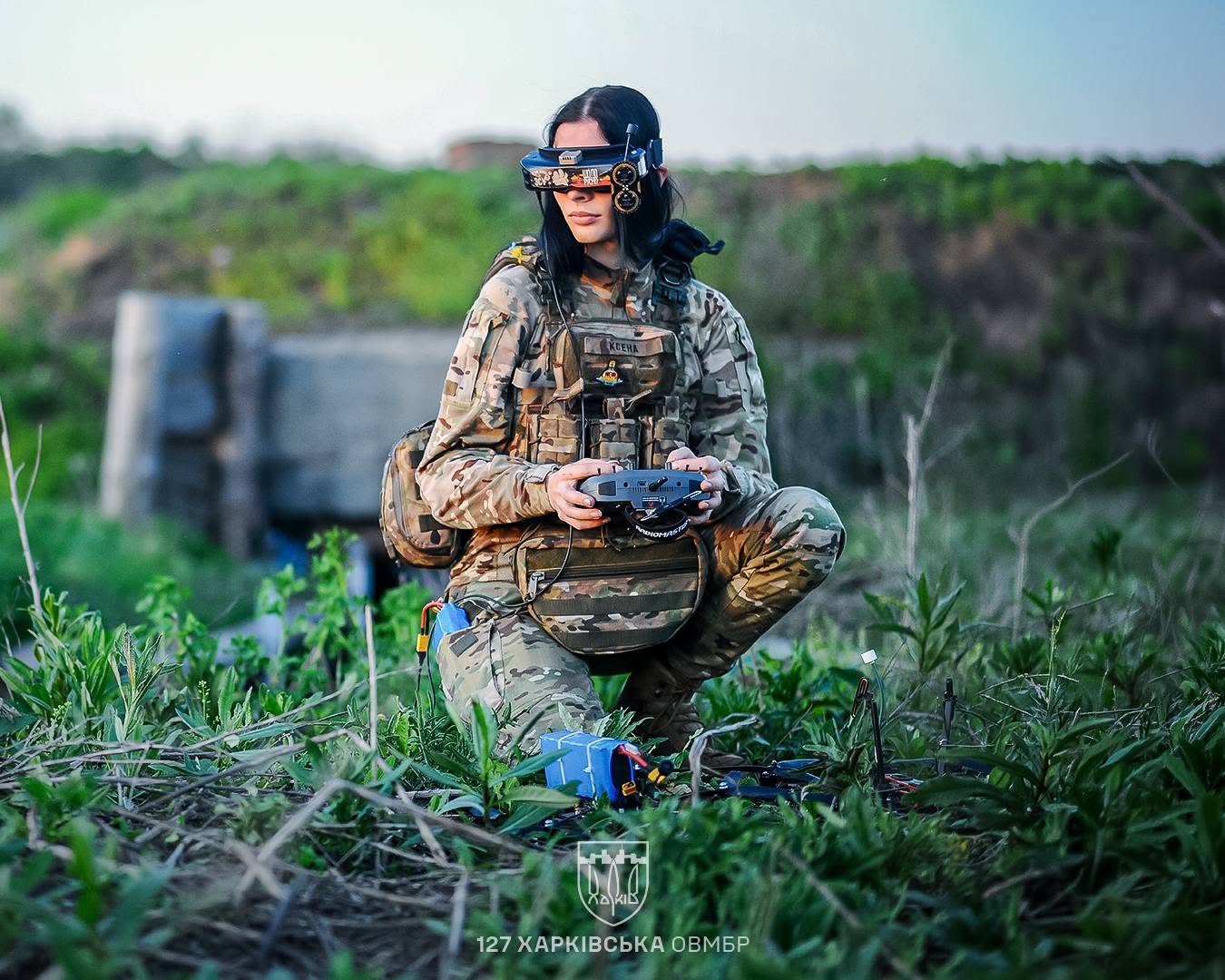
A Ukrainian soldier operating an FPV drone with headset goggles
A Ukrainian drone operator navigates the battlefield. FPV drones have become the defining tactical innovation of the conflict, substituting for traditional artillery. Credit: Wikimedia Commons / CC BY 4.0

Since the initial invasion, the conflict in Ukraine has evolved from a maneuver war of rapid armored thrusts into a grueling, static war of attrition. Stalemated by dense minefields and deep fortifications, both sides have been forced to innovate rapidly to break the deadlock. The most defining tactical shift has been the mass deployment of First-Person View (FPV) drones, which have fundamentally altered the modern battlespace by providing precision air support in a war where neither side has achieved air superiority.

Read More →

Territorial Control & Troop Movements

Territorial Control & Frontline Updates

Open-source intelligence assessments

Russia
Ukraine (Sovereign Borders)
Russian-Occupied Territory
Recent Russian Offensive (Avdiivka axis)
Territorial Control Map. The frontline has largely frozen into a grueling war of attrition. Breakthroughs are measured in meters.

Russia holds about 20% of Ukrainian territory — 45,660 square miles on ISW's count, 45,156 on DeepState's, including Crimea and the Donbas taken before February 2022. The front has all but stopped moving. ISW recorded no confirmed advance by either side anywhere on the front on July 24, 25 and 26, three days running, and DeepState measured Russian-controlled area growing 9.76 sq km over the past week — about 1.4 sq km a day, against 2–3 in June and early July and 8–14 a day in late 2025. Across the four Donetsk sectors carrying Russia's main effort the weekly gain halved, 17.33 sq km to 6.92. Russian sources nonetheless claimed five settlements seized in those three days, one of them on footage ISW assesses was likely AI-altered; ISW confirmed none. Kostyantynivka is still contested rather than captured on both ISW's and DeepState's readings, and the Dobropillya axis flagged last cycle produced no advance in four days.

Read More →

The Supply & Demand Deficit

Monthly Weapons Requirement vs. Procurement

$B / month

Monthly Requirement
Monthly Procurement
Shortfall
Estimated Averages (H1/H2 & Current)
Procurement has climbed since 2022 but has never closed the gap: Ukraine still runs a $1.9B monthly shortfall against its assessed requirement.

Ukraine runs a continuous supply-demand deficit and is offsetting artillery shortfalls by scaling domestic unmanned-systems production and deepening joint ventures with European industry. The structural shift this year is production rights rather than deliveries — but the rights are proving slower to arrive than the announcements. Britain handed over the IP for its 'Stone Cloak' drone jammer on July 27 so Ukraine can manufacture it itself; Zelensky said on July 23 that Ukraine would co-produce Patriot interceptors with Raytheon, though nothing is signed and the company says US licensing has only just begun; and the Patriot production licence Trump pledged at the Ankara summit has still not been issued. Officials put a first pilot interceptor line 18 to 24 months away. On the money side, imported supply now runs mainly through NATO's PURL mechanism, which Ukraine's defence ministry says delivered $6.7 billion from 29 countries in its first year, while $400 million appropriated by Congress remains unobligated.

Read More →

I believe Vladimir Putin is ready to reach a peace agreement soon and I hope the war will conclude during my administration.

Context: False as of July 2026. Trump's claim has now been overtaken by Russia's own on-the-record position, twice in three days. On July 22 Kremlin spokesman Dmitry Peskov said Putin's June 2024 demands — complete Ukrainian withdrawal from the parts of Luhansk, Donetsk, Zaporizhia and Kherson oblasts Ukraine still holds, plus abandonment of NATO accession — remain the basis of Russia's conditions for ending the war; those are the terms Russia set when its forces were advancing, and Ukraine has never accepted them. On July 23, after Secretary of State Marco Rubio met Foreign Minister Sergei Lavrov in Manila, Rubio said Russia's Anchorage proposals had failed and that no agreement to end the war exists — while the Russian Foreign Ministry said the same day that Lavrov had reaffirmed Russia's commitment to proposals Putin agreed to at Anchorage. The two governments cannot agree on what was agreed, which is itself dispositive: a party ready to reach an agreement soon does not need to dispute the existence of the last one. Bloomberg reported on July 22, citing three people close to the Kremlin, that Putin intends to take the rest of Donetsk by force before returning to talks. The verdict moves from unverified to false on the substance — readiness — not on the timeline; 'soon' has now passed without any negotiating format existing in published form.

There is no immediate prospect for resuming peace talks with Ukraine, though Russia remains open to it.±

Context: Mixed, and the two halves have now separated cleanly. The first half — 'no immediate prospect for resuming peace talks' — has borne out: no negotiating format has convened, the Rubio–Lavrov meeting of July 23 produced contradictory readouts rather than a process, and Zelenskyy on July 23 spoke of trilateral talks only in the autumn. The second half — that 'Russia remains open to it' — is contradicted by Peskov himself six days later: on July 22 he restated Putin's June 2024 maximalist demands as the basis of Russia's conditions, and Bloomberg reported the same day, citing three people close to the Kremlin, that Russia will return to talks only after seizing all of Donetsk Oblast by force, a timeline ISW assesses Russian forces are 'extremely unlikely' to meet. Openness conditioned on the other side's capitulation, or on a military outcome the assessing institution considers unachievable, is not openness in the sense the statement invites readers to take. Accurate on the forecast, misleading on the posture.

The situation on the front, together with our long-range sanctions and mid-range strikes, is creating a new atmosphere around Putin. A very toxic atmosphere. He alone is the reason this war began and hasn't ended. Putin alone is responsible for the losses Russians continue to suffer. His retinue understands this – they are signalling it to us and to our partners. Russian society is beginning to feel it more and more as well.?

Context: Unverified. Zelenskyy's characterization of a 'toxic atmosphere' inside Putin's inner circle and of aides distancing themselves from Putin cannot be independently confirmed from open sources; it is an assertion about private Russian elite sentiment. It is in direct tension with the Kremlin's own conduct the same week: Bloomberg reported on July 22 that Moscow had hardened its territorial demands — no longer offering to return occupied parts of Sumy and Kharkiv oblasts — and Putin remained set on taking all of Donetsk by force before any talks, behavior that signals confidence rather than a leader under internal pressure. Two further data points this cycle cut the same way without settling it: on July 22 Putin chaired a meeting on the economy and asserted it 'remains stable despite external attempts to destabilise the fuel and energy sector', and Peskov restated the June 2024 maximalist demands as Russia's terms — public conduct consistent with confidence rather than isolation. Set against that, independent indicators of strain accumulated in the same week (the Moscow Exchange's largest single-day fall since September 2022 on July 16; a 7.9% rise in the minimum food basket since January; over 81% of gasoline purchase requests unfulfilled), and Ukrainian strikes reached the consumer economy for the first time. None of that is evidence about the sentiment of Putin's retinue, which is what the claim asserts and what remains unobservable. Stays unverified.

Let me note at the outset of our meeting that the state of the Russian economy, and of its key sectors, remains stable despite external attempts to destabilise the fuel and energy sector and certain other industries.±

Context: Mixed. Putin's own cited figures are modest but not disputed — GDP growth of 0.3% in May 2026 and 0.2% across the first five months, a 196-billion-rouble (about $2.51 billion) June surplus — and he acknowledged growth was 'modest'. But the same figures include money-supply growth of 13% year on year, which points to continued inflation rather than stability, and three independent indicators published in the same week cut against the claim: the Moscow Exchange composite index recorded its largest single-day decline since September 2022 on July 16; the food-industry association Rusprodsoyuz told TASS on July 21 that the monthly minimum food basket has risen 7.9% since the start of 2026; and Kommersant reported on July 20, citing Platts, that Russian refineries have yet to fulfil over 81% of gasoline purchase requests — a fuel shortage Putin characterised as temporary but which shows no sign of easing. 'Stable' is defensible on the headline aggregates and not on the fuel market or on prices.

EU Adopts Its Largest Sanctions Package in Four Years

The Council of the European Union adopted its 21st package of restrictive measures against Russia on July 23, carrying 218 individual listings — 48 people and 170 entities — which the Council describes as the largest batch of listings in four years. The financial measures freeze the assets of 94 banks and major financial institutions and extend the EU's transaction ban to 33 further Russian credit and financial institutions, to 14 crypto-service platforms based in Georgia, Panama, the UAE, the Marshall Islands, Kyrgyzstan and Belarus, and — for the first time — create the possibility of a blanket third-country ban on crypto services used by Russia. On energy, 41 more shadow-fleet tankers were listed on top of the 632 already sanctioned, bringing the total to 673, alongside three Russian refineries, a major Belarusian refinery, and a transaction ban on a Georgian refinery at Kulevi that takes effect in six months. Fifty-six listings target the military-industrial complex, 37 of them tied directly to long-range drone production, and 51 entities were added to tighter dual-use export controls — including firms in China and Hong Kong, India, Kazakhstan, Kyrgyzstan, Türkiye and the UAE — over circumvention in microelectronics, CNC machine tools and semiconductor-processing equipment. The package also pauses the automatic adjustment of the Russian oil price cap until July 15, 2027, citing the market shock from the closure of the Strait of Hormuz, and lays the legal basis for a visa ban on Russian combatants that the Council has not yet brought into force. DW reported, citing two unnamed EU diplomats, that weeks of deadlock broke after Greece secured an exemption allowing one of its shipping firms to keep carrying Russian LNG from the Arctic; the Council's own release mentions no such exemption.

Ballistic Strike on Defence-Industry Gathering Near Kyiv Kills at Least 10

A Russian ballistic missile struck the grounds of a privately operated military training site in the Bucha district, 20 to 30 kilometres from central Kyiv, that was hosting a defence-industry event on July 24, killing at least 10 people and wounding nearly 100 according to Ukrainian government and industry officials. The Ukrainian Defence Industry Council, the country's largest association of private defence manufacturers, said industry representatives were at the site when it was hit; acting regional military administration head Ruslan Oliinyk reported 27 homes and 44 vehicles also damaged. The Ukrainian government imposed reporting restrictions on the attack, so the figures may be incomplete. Prosecutor General Ruslan Kravchenko opened two cases — a war-crimes investigation into the strike itself and, unusually, a separate criminal case over possible negligence by the event's Ukrainian organisers, with investigators to examine who approved its location, timing and format. The strike came a day after Zelenskyy met senior Raytheon representatives in Kyiv and said the maker of the Patriot system was ready to co-produce interceptors with Ukraine — a claim Raytheon has not confirmed — and Zelenskyy said afterwards that 'missiles for the Patriot systems are the top priority'.

Russia Hits Kyiv With One of the War's Largest Missile Barrages

On the night of July 18–19, Russia struck Kyiv and other cities with one of its largest ballistic missile barrages of the war — roughly 40 missiles, including Iskander-M/S-400 ballistic missiles, Zircon hypersonic missiles, and Onyx and Kh-59/69 guided missiles, alongside about 125 strike drones over a five-hour assault. Ukraine's Air Force downed 18 missiles and 108 drones, but at least one civilian was killed and up to 16 wounded in Kyiv, with at least six killed nationwide — including three at a Nova Poshta postal terminal in Kharkiv and a 16-year-old in Odesa — while a cruise-missile strike on the Guinea-Bissau-flagged bulk carrier Golden Leo near Odesa killed 10 — nine crew members, among them four Indian nationals, and a Ukrainian maritime pilot — the deadliest attack on a merchant ship of the war as Russia intensifies strikes on the Black Sea grain corridor. Zelenskyy said Russia had spent days stockpiling missiles for the strike and was exploiting a global shortage of Patriot interceptors, the munition best able to down ballistic missiles; the ISW noted Russia is now launching more ballistic missiles than it produces each month, drawing down its stockpiles while cutting drone volumes. Acting Foreign Minister Andrii Sybiha called it "a brutal terrorist attack" and said "the coward in Moscow, who is afraid to meet with President Zelenskyy to end the war, continues to wage a war against civilians" — the barrage undercutting President Trump's July 15 prediction that Putin was "ready to reach a peace agreement soon."

Ukraine Strikes Moscow With Hundreds of Drones in Retaliation

On the night of July 19–20, a day after Russia's record barrage on Kyiv, Ukraine struck Moscow and the surrounding oblast with hundreds of drones — Russian officials said roughly 400 were aimed at the Moscow region. Geolocated footage confirmed drones hitting a Wildberries logistics warehouse in Domodedovo, while Russian opposition monitors and NASA fire-detection data placed a second strike on an oil depot in Podolsk; President Zelenskyy acknowledged hitting an oil depot and logistics facilities in Moscow Oblast. Moscow Mayor Sergei Sobyanin and Oblast Governor Andrei Vorobyov confirmed the attack, which authorities said wounded at least 10 people. The same night Ukraine's Unmanned Systems Forces reported destroying six Russian air-defense systems — a Tor-M2 launcher and Kasta-2E2, Gamma-C1M and two Nebo-SV radars — in Krasnodar Krai, part of a sustained effort to peel back Russia's air-defense umbrella. The strike extended the tit-for-tat long-range exchange that has come to define the war with the frontline frozen.

Ukraine Launches Mass Deep-Strike Wave Into Russia

Ukrainian drones struck sites deep inside Russia in one of the largest single-wave operations of the war, killing at least nine people and wounding more than 60, according to Russian officials. Two Wildberries logistics warehouses were hit — in Kotovsk (Tambov region) and in Elektrostal, roughly 50km east of Moscow — and an oil depot in Noginsk caught fire. Russia's Defense Ministry said it intercepted 379 drones over 19 regions. Zelenskyy said the targeted facilities supplied sanctioned components for Russian drone and navigation-equipment production. Independent Russian outlets later estimated the strikes damaged roughly 7–15% of Wildberries' warehouse capacity, with losses of around 100 billion rubles (~$1.28 billion).

Wagner Group Mutiny

Wagner Group chief Yevgeny Prigozhin launched an armed mutiny against Russia's military leadership, seizing the army headquarters in Rostov-on-Don and marching an armored column to within roughly 200km of Moscow before a Belarus-brokered deal halted the revolt the same day. The most serious internal challenge to Putin's rule during the war, it ended with Prigozhin exiled to Belarus; two months later, on August 23, 2023, he was killed when his jet crashed in Russia.